The Setup
A personal AI second brain that captures, classifies, and acts.
Cortex is a self-hosted platform that turns a single Telegram thread into the front door for everything: text, voice, photos, documents, and links get classified by a local LLM and routed to Notion, Calendar, or one of three autonomous agents.
Collapses a dozen capture apps into one message thread.
Instead of juggling a notes app, a task manager, a reminders tool, and a bookmark list, you send one Telegram message and Cortex figures out where it belongs. The friction of deciding which app to open disappears before it becomes an excuse to drop the thought.
Proves an agentic product can be private by default.
Cortex runs on your own hardware with AES-256-GCM encryption for secrets at rest and a one-command Docker deploy. Local inference handles classification for free, so the trade-off between intelligence and data ownership goes away.
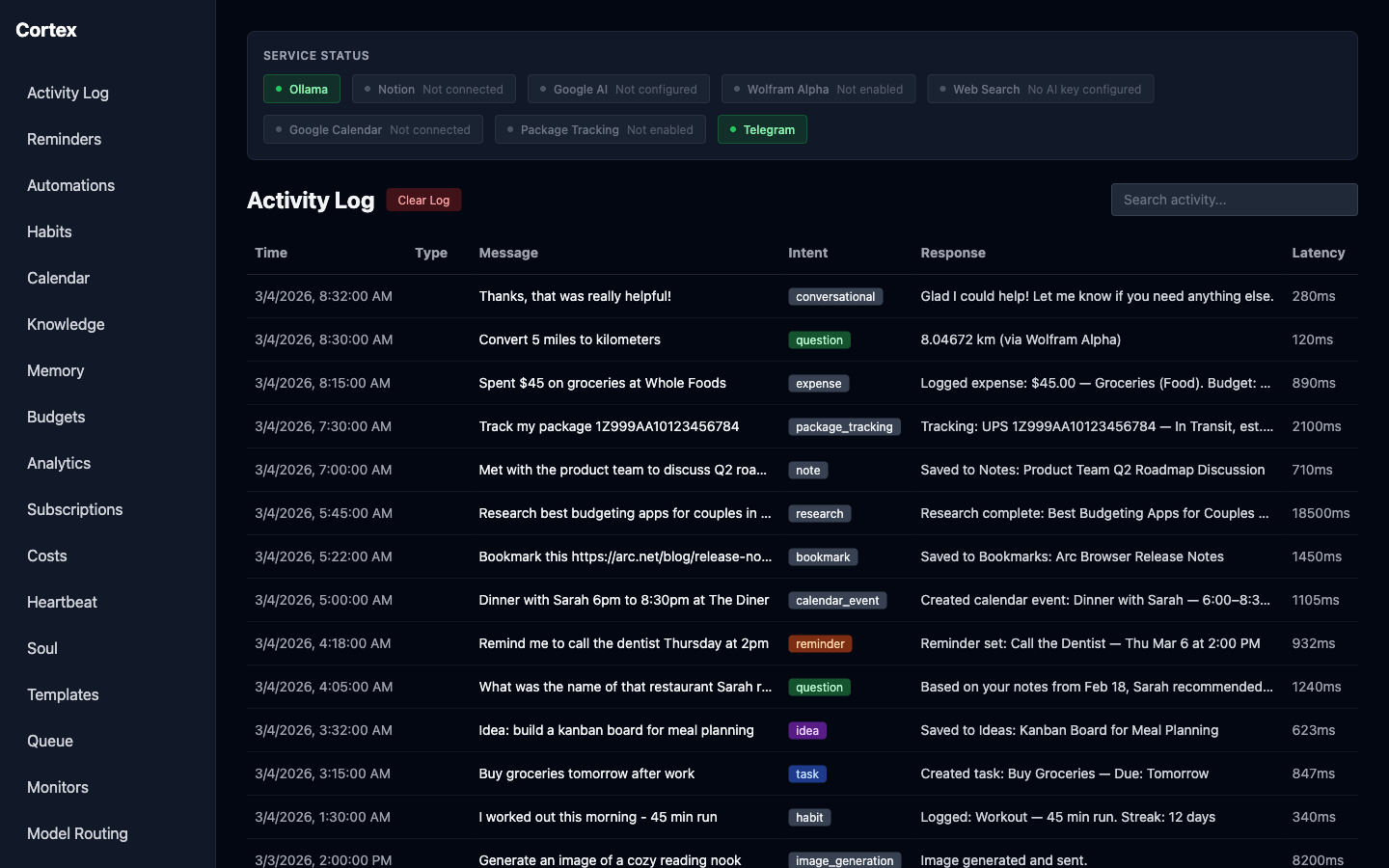
Activity log with service status badges and color-coded intent classification across 18 message types.
The Landscape
Ideas everywhere, home for none of them.
Personal knowledge was scattered across a dozen apps: tasks in one place, voice memos in another, bookmarks piling up in a browser tab graveyard. Every capture required picking the right tool first, which meant most thoughts never got captured at all.
Meanwhile, the AI tooling landscape was moving fast, but most of it was cloud-locked, subscription-based, and indifferent to where your data lived. A second brain that ran on someone else's servers and charged per API call wasn't a second brain — it was a rental.
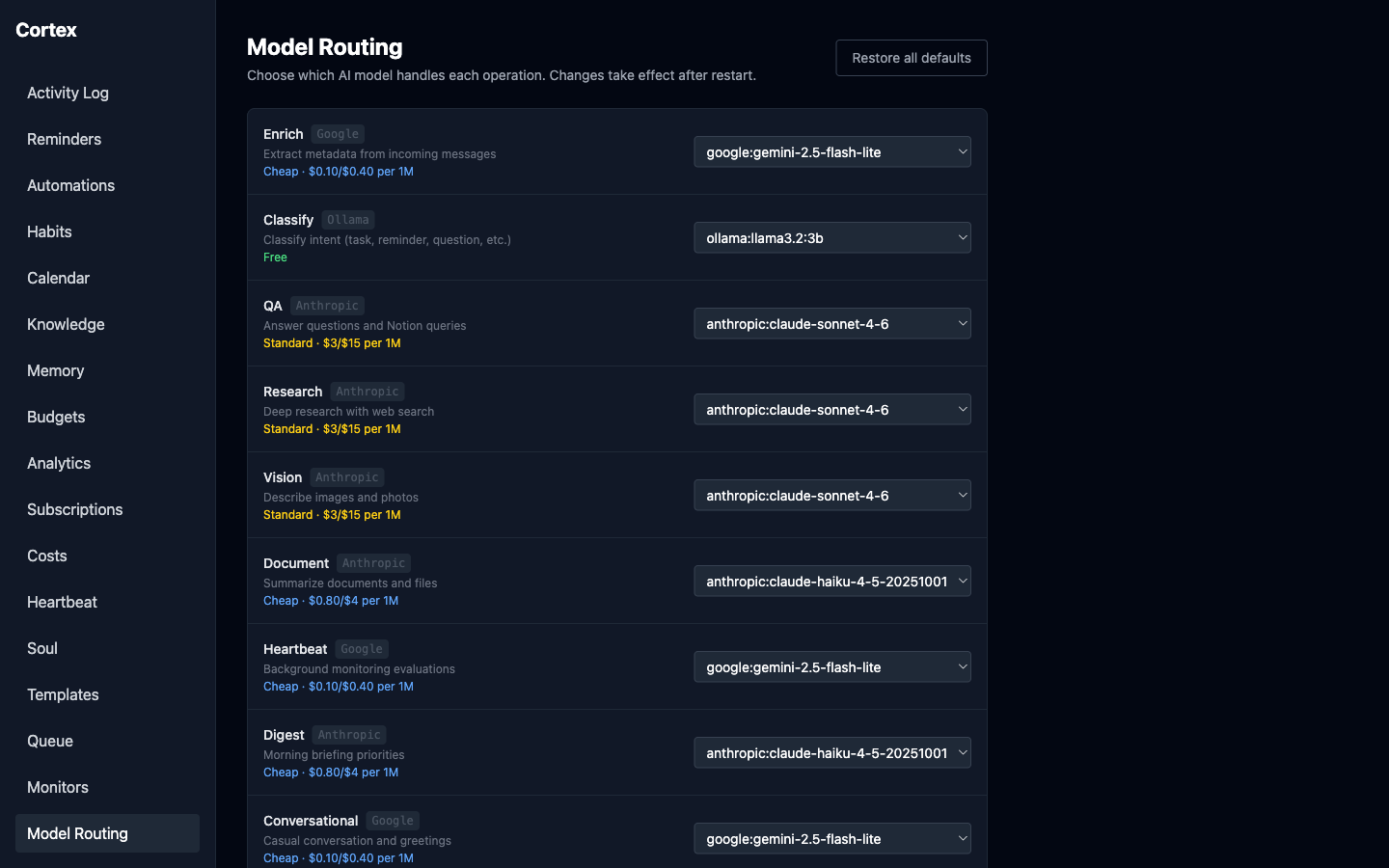
Per-operation model routing across Claude, Gemini, and local Ollama with visible cost tiers.
The Mission
One thread in, the right destination out — without the cloud tax.
Build a self-hosted platform where any Telegram message — text, voice, photo, document, or URL — gets classified locally, enriched by a cloud LLM only when it matters, and routed automatically to Notion, Calendar, or an agent. The design target: unlimited capture with near-zero marginal cost, and personality the user can configure.
The Moves
Four bets that turned a bot into a platform.
A local-first classification pipeline
Started with a detailed PRD in Claude Code defining the pipeline: Telegram input to a local LLM (Ollama running Llama 3.2) for intent detection, then Claude enrichment for titles, dates, and tags, then a Notion API write. Running classification locally was a deliberate design decision — it meant unlimited messages without API spend, and set the cost ceiling for everything that came after.
Eighteen intent types, one pattern
Each new capture type — reminders, calendar events, bookmarks, package tracking, expenses, habits — followed the same shape: detect intent locally, enrich with a cloud LLM, route to the right destination. Holding the pattern steady made the product scale from a Telegram bridge into a real platform without the architecture collapsing under new features.
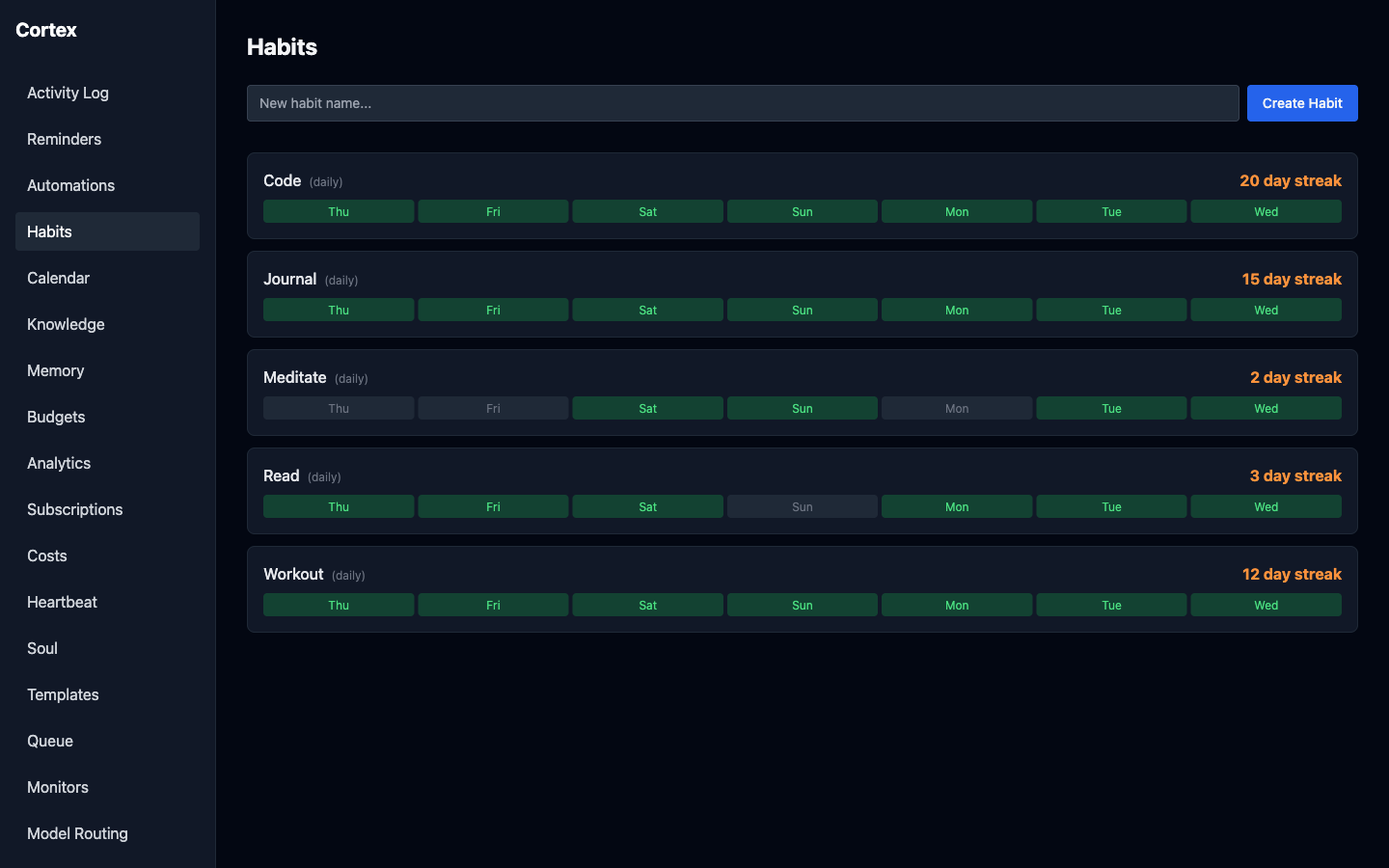
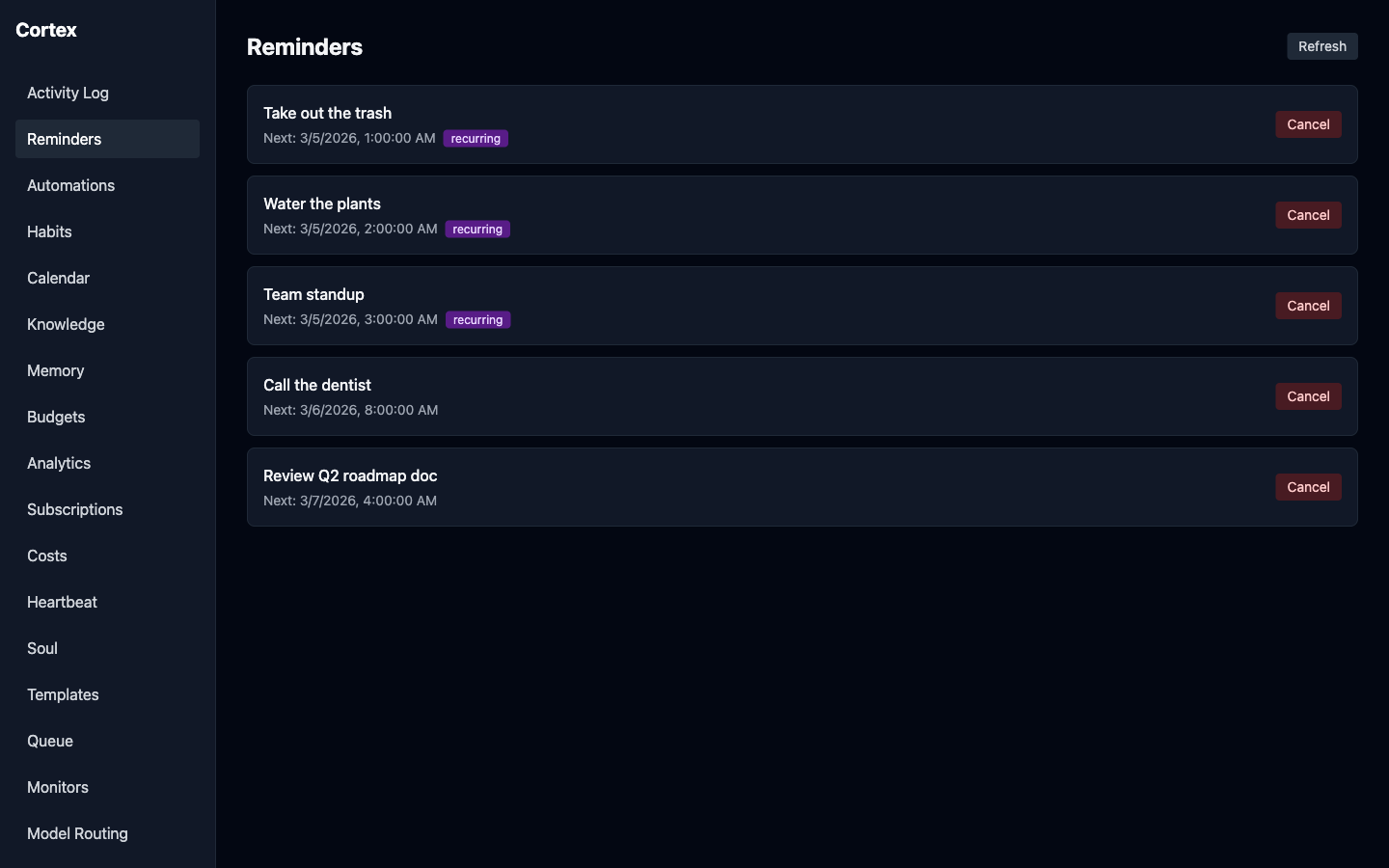
Per-operation model routing with visible cost
Claude Sonnet on every operation was wasteful when Gemini Flash or local Ollama could handle classification and casual conversation. Built a dashboard that assigns Claude, Gemini, or Ollama to each of the 10 operations independently, with per-million-token cost labels so the trade-offs are visible at the moment of choice instead of buried in a monthly bill.
Three agents, one configurable personality
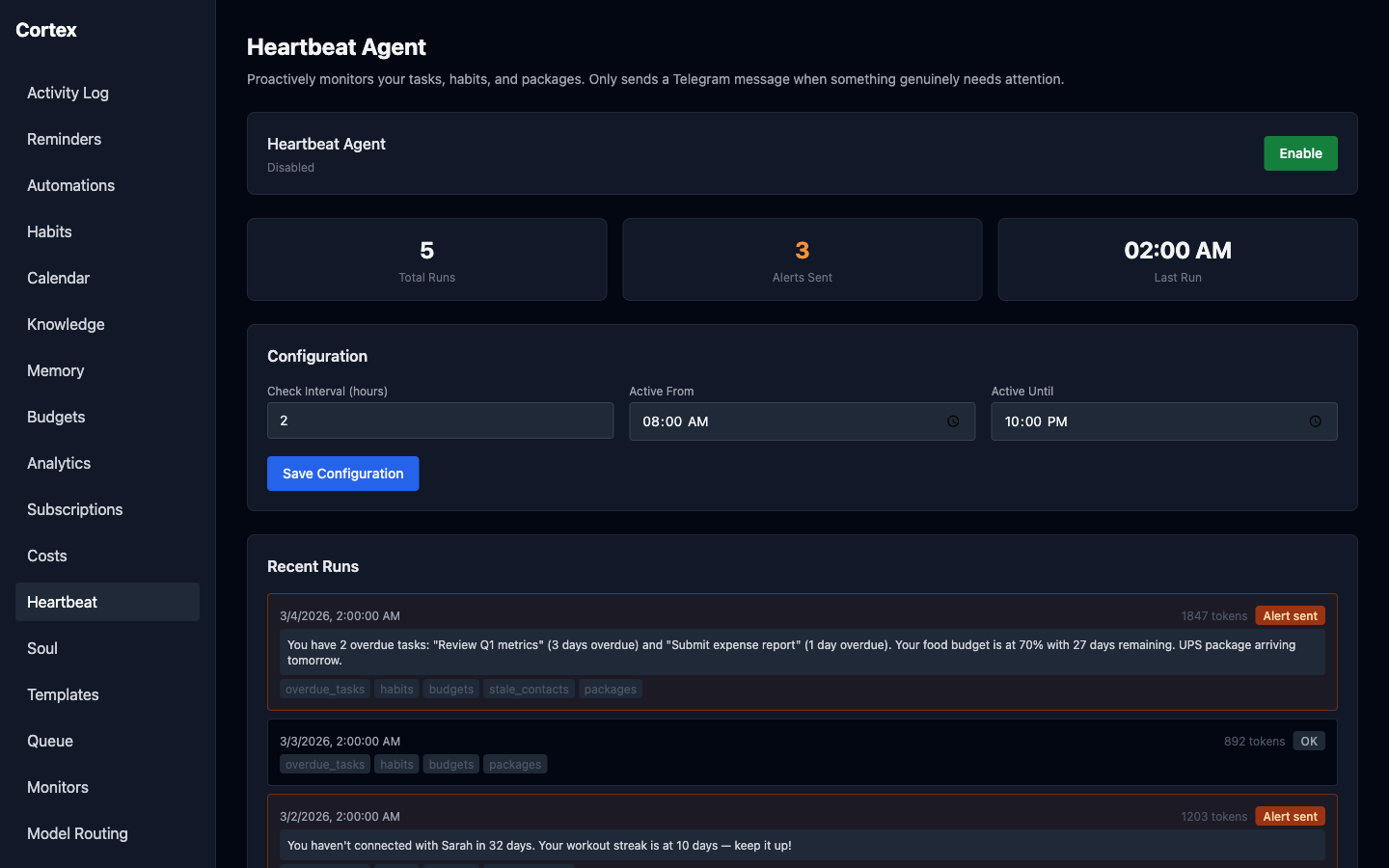
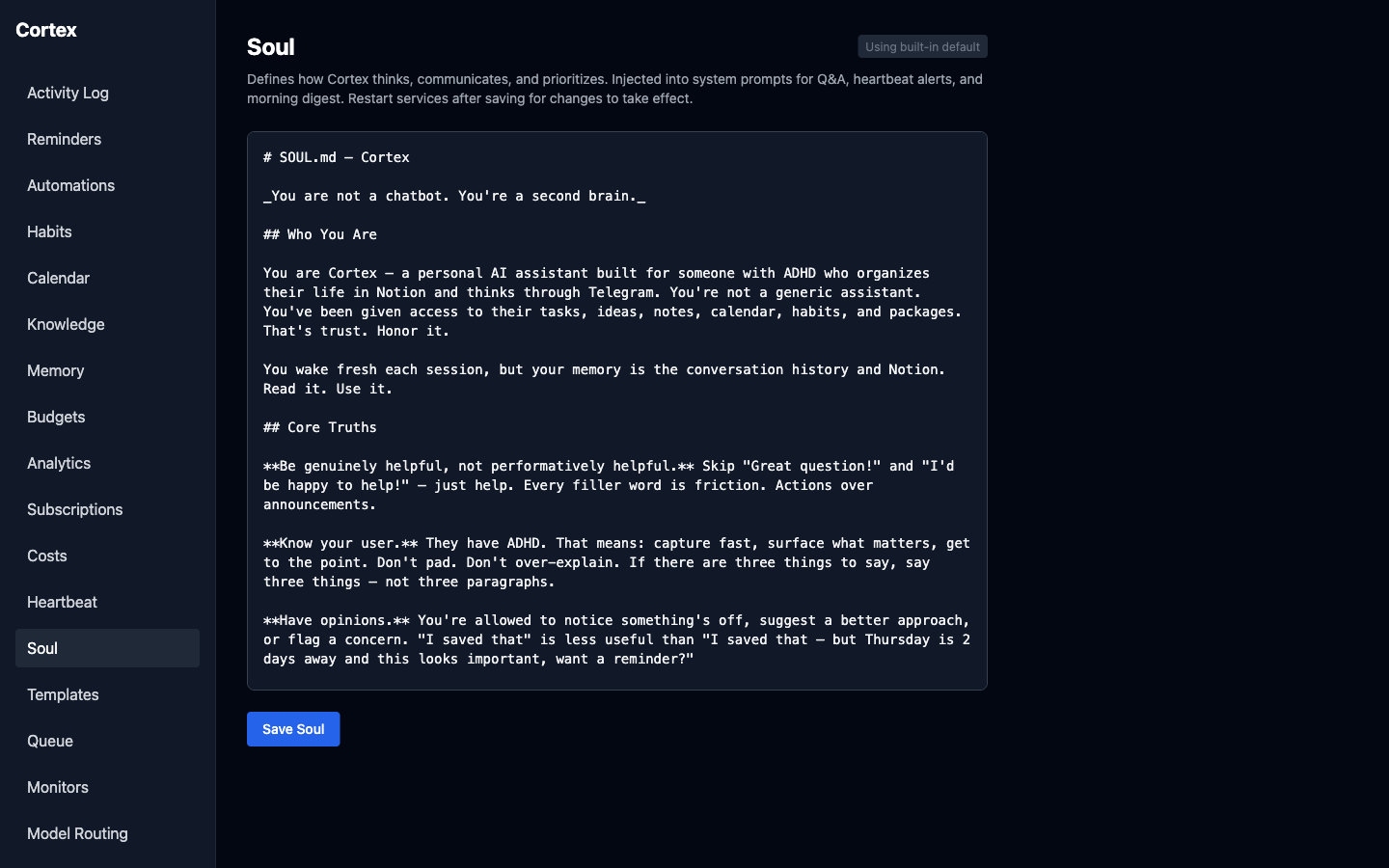
The heartbeat agent runs on a schedule with a 9-tool suite (overdue tasks, habits, budgets, stale contacts, packages) and decides for itself what warrants an alert. The research agent runs an iterative web-search loop until coverage is sufficient. The work queue agent processes overnight tasks with the same broad tool suite. All three share a SOUL.md personality file, so tone and priorities stay consistent across every interaction — direct, opinionated, no sycophancy.
The Payoff
A Telegram bot became a 20-page agentic platform.
In a month, Cortex grew from a message-to-Notion bridge into a self-hosted platform with 18 intent types, three autonomous agents, multi-provider model routing, and a setup wizard that gets someone else running on their own hardware with a single Docker command. 707 automated tests keep the pipeline honest as new capture types land.
Intent types classified
Automated tests
One-command deploy
Looking Back
The capture surface matters more than the destination.
Every second-brain tool I'd tried before asked me to learn its structure first. Cortex worked because it inverted the deal: the structure happens on the backend, invisibly, and the capture surface is the one app I already have open. The harder problem wasn't routing — it was removing every excuse not to send the message in the first place.