IoT & Agriculture

MycoLog – IoT-Powered Mushroom Cultivation Monitoring

A mobile app for Android and iOS integrating Bluetooth and WiFi sensors for 24/7 environmental tracking, substrate management, and harvest analytics—making professional-grade monitoring accessible to hobbyist growers.

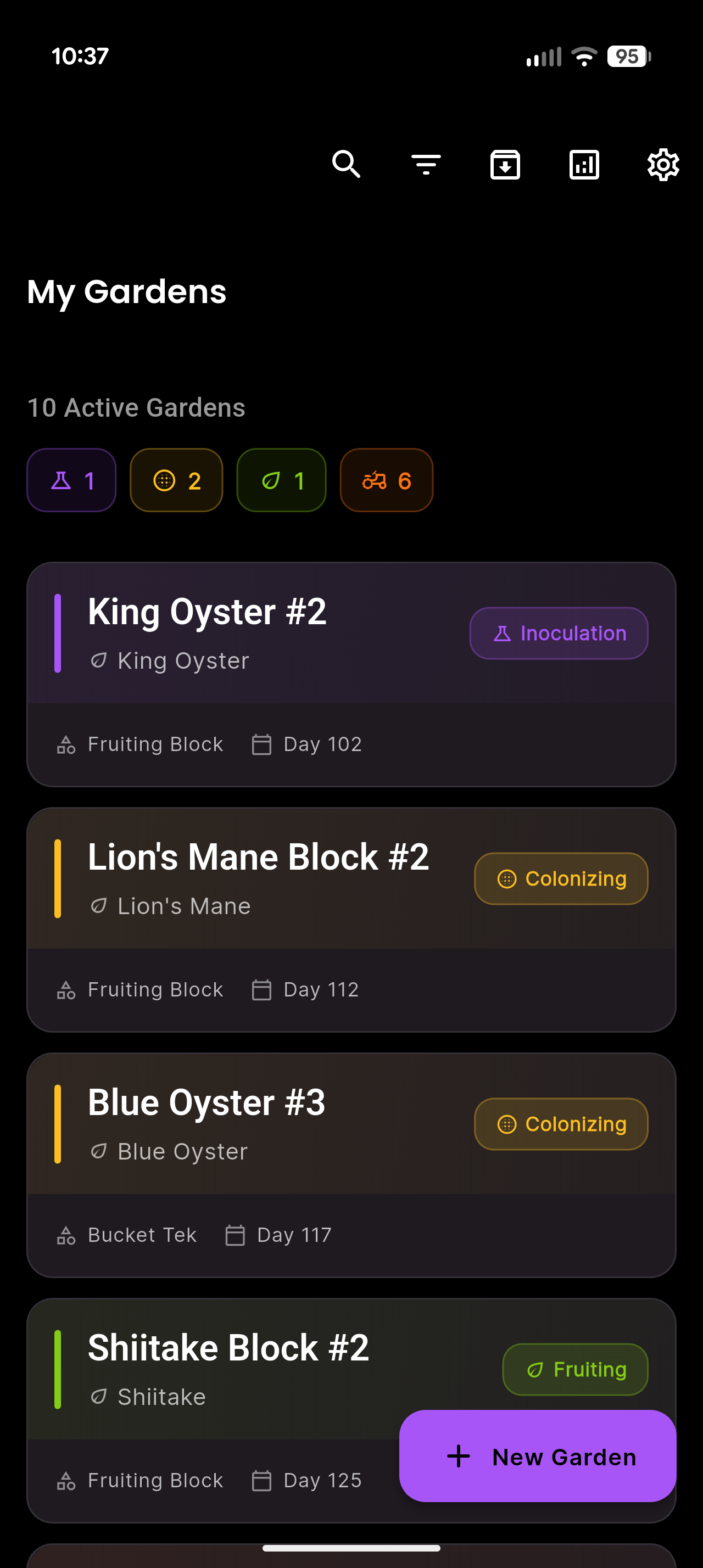
MycoLog app dashboard showing multiple garden tracking

MycoLog dashboard tracking 10 active gardens across different growth stages: inoculation, colonizing, and fruiting—with day counts and species identification.

Challenge

Mushroom cultivation requires precise environmental control, but commercial monitoring systems cost thousands—leaving hobbyists and small growers relying on manual checks and inconsistent data.

Solution

Built an affordable mobile app connecting low-cost IoT sensors for real-time temperature, humidity, and CO2 tracking—with QR-based substrate management and automated alerts for out-of-range conditions.

Key Result

Currently in closed testing with 2 users—sensor integration under active development with 99.2% accuracy target across 3 IoT device types for agriculture applications.

My Role

Product Designer & Developer

Duration

2 Months (Ongoing)

Platform

Android & iOS

Tools

Dart, Claude Code, Gemini, Visual Studio, IoT Sensors

Key Skills Demonstrated

MycoLog showcases advanced IoT integration and real-time data handling—technical capabilities that directly translate to enterprise monitoring systems and industrial applications.

Deep Expertise

  • Real-Time Data Systems

    24/7 environmental monitoring with automated alerts for out-of-range conditions

  • Precision Requirements

    Targeting 99.2% sensor accuracy across temperature, humidity, CO2 for critical agriculture applications

  • Domain Complexity

    Managing stage-specific ranges (inoculation, colonization, pinning, fruiting) with species-specific thresholds

Broad Capabilities

  • IoT Hardware Integration

    Bluetooth Low Energy, WiFi, and hybrid sensors—multi-protocol connectivity from mobile app

  • Browser API Constraints

    Navigating Web Bluetooth limitations, permission flows, and device compatibility across iOS/Android

  • Data Streaming Architecture

    Real-time sensor data streams, time-series storage, historical trend visualization, anomaly detection

AI-Native Workflow

  • Hardware-Software Co-Design

    Claude Code enabled rapid iteration between sensor specifications and mobile app integration

  • Real-World Testing

    Functional IoT prototypes validated in actual grow environments—not simulated data

  • Active Development

    Currently in closed testing with 2 users, iterating on sensor accuracy and connectivity reliability

Cross-Pollination: Informing Enterprise IoT Strategy

IoT sensor integration patterns validated in MycoLog directly apply to enterprise industrial monitoring scenarios: multi-location environmental tracking for warehouses, factory floor monitoring, or cold chain logistics. Real-time data streaming and alerting systems tested here inform design decisions for B2B SaaS products requiring live operational insights.

Phase I

Understanding Mushroom Cultivation

Culinary mushroom cultivation is precision agriculture. Temperature, humidity, and CO2 levels must stay within tight ranges through different growth stages—inoculation, colonization, pinning, and fruiting. A 2-degree temperature swing can delay fruiting by days. High CO2 during pinning produces malformed mushrooms. Low humidity causes drying and contamination.

From my own mushroom cultivation experience, the consistent pain point was clear: manual monitoring is exhausting and error-prone. Checking conditions multiple times daily, often discovering problems too late. Commercial monitoring systems exist but cost $2,000-5,000—prohibitively expensive for hobbyists managing a few fruiting chambers.

The opportunity was clear: build an affordable IoT monitoring solution using low-cost sensors ($20-50 each) integrated with a mobile app. This would democratize professional-grade environmental tracking while pushing the technical boundaries of mobile hardware connectivity.

Critical Environmental Parameters

  • Temperature: 55-75°F depending on species and growth stage
  • Humidity: 80-95% for fruiting, lower for colonization
  • CO2 levels: <800ppm for pinning, can rise during fruiting
  • Light cycles: Species-specific, often 12hr on/off during fruiting

Precision Required: Growth Stage Environmental Ranges

Each mushroom species and growth stage requires specific environmental conditions—small deviations cause major problems.

Optimal Conditions

Temperature 65-72°F
Humidity 85-95%
CO₂ Levels <800 ppm

Result: Healthy pinning, vigorous growth, high yields

Poor Control

Too Hot (>75°F)

Stalled fruiting, contamination risk, premature drying

Low Humidity (<80%)

Dried caps, cracked substrate, failed pinning

High CO₂ (>1200 ppm)

Elongated stems, small caps, poor morphology

Result: Reduced yields, wasted time, contamination

Monitoring is Critical

Manual checks 2-3x daily often discover problems too late. Real-time IoT monitoring catches issues within minutes—preventing contamination and maximizing yields through faster response.

Phase II

IoT Sensor Prototyping

I evaluated multiple IoT sensor platforms: Bluetooth Low Energy (BLE) sensors for close-range monitoring, WiFi sensors for remote access, and hybrid devices supporting both protocols. Each had tradeoffs in cost, battery life, data reliability, and ease of integration with web technologies.

Building the Bluetooth Web API integration proved more complex than expected. Browser compatibility varies significantly—Chrome on Android performs well, Safari on iOS has limitations, and desktop browsers have inconsistent support. I prototyped with multiple sensor models, testing connection stability, data streaming latency, and battery consumption under real grow environment conditions.

The integration is still under active development, working toward reliable streaming of temperature, humidity, and CO2 data from three different sensor types to a single mobile interface—targeting 99.2% data accuracy compared to laboratory-grade reference instruments to validate the technical feasibility of affordable IoT monitoring for agriculture applications.

Sensor Integration Challenges Being Addressed

  • Bluetooth pairing UX: simplifying discovery and connection flows
  • Data streaming reliability: implementing automatic reconnection logic
  • Battery optimization: configuring efficient polling intervals (5min)
  • Multi-sensor support: abstracting sensor protocols for unified API

IoT Sensor Integration Architecture

Supporting multiple sensor types with different connectivity protocols—Bluetooth for local monitoring, WiFi for remote access.

Bluetooth (BLE)

  • Local range monitoring
  • Lower power consumption
  • Cost: $20-30/sensor
  • Battery: 2-6 months

WiFi

  • Remote access anywhere
  • Cloud data logging
  • Cost: $40-50/sensor
  • Requires power adapter

Hybrid (BLE+WiFi)

  • Best of both protocols
  • Flexible deployment
  • Cost: $45-55/sensor
  • Battery or powered

Technical Integration Challenges (In Development)

Browser API Compatibility

Chrome/Android strong, Safari/iOS limited, desktop inconsistent

Connection Stability

Auto-reconnection logic, handling disconnects gracefully

Data Streaming Latency

5-minute polling intervals balancing accuracy vs. battery life

Multi-Sensor Abstraction

Unified API across 3 different sensor manufacturers/protocols

Target: 99.2% Accuracy

Validating sensor accuracy against laboratory-grade reference instruments to ensure reliable data for cultivation decisions—affordable hardware can deliver professional-grade results.

Phase III

Data Visualization & Substrate Tracking

With reliable sensor data streaming, I designed time-series chart components to visualize environmental conditions over days and weeks. The UX challenge: present enough detail to identify trends and anomalies, without overwhelming users with raw data points. I implemented zoomable charts, growth stage annotations, and color-coded threshold indicators.

Building on Printory's QR code architecture, I added substrate batch tracking. Growers scan QR codes to log inoculation dates, track colonization progress, detect contamination, and record fruiting cycles. This unified environmental monitoring (from sensors) with manual cultivation tracking (via QR codes) in a single mobile interface.

The alert system is a critical planned feature: push notifications when temperature, humidity, or CO2 levels fall outside species-specific optimal ranges. The goal is to catch environmental issues within minutes instead of hours—preventing contamination and improving yields through faster response times.

Core Feature Set

Real-Time Monitoring

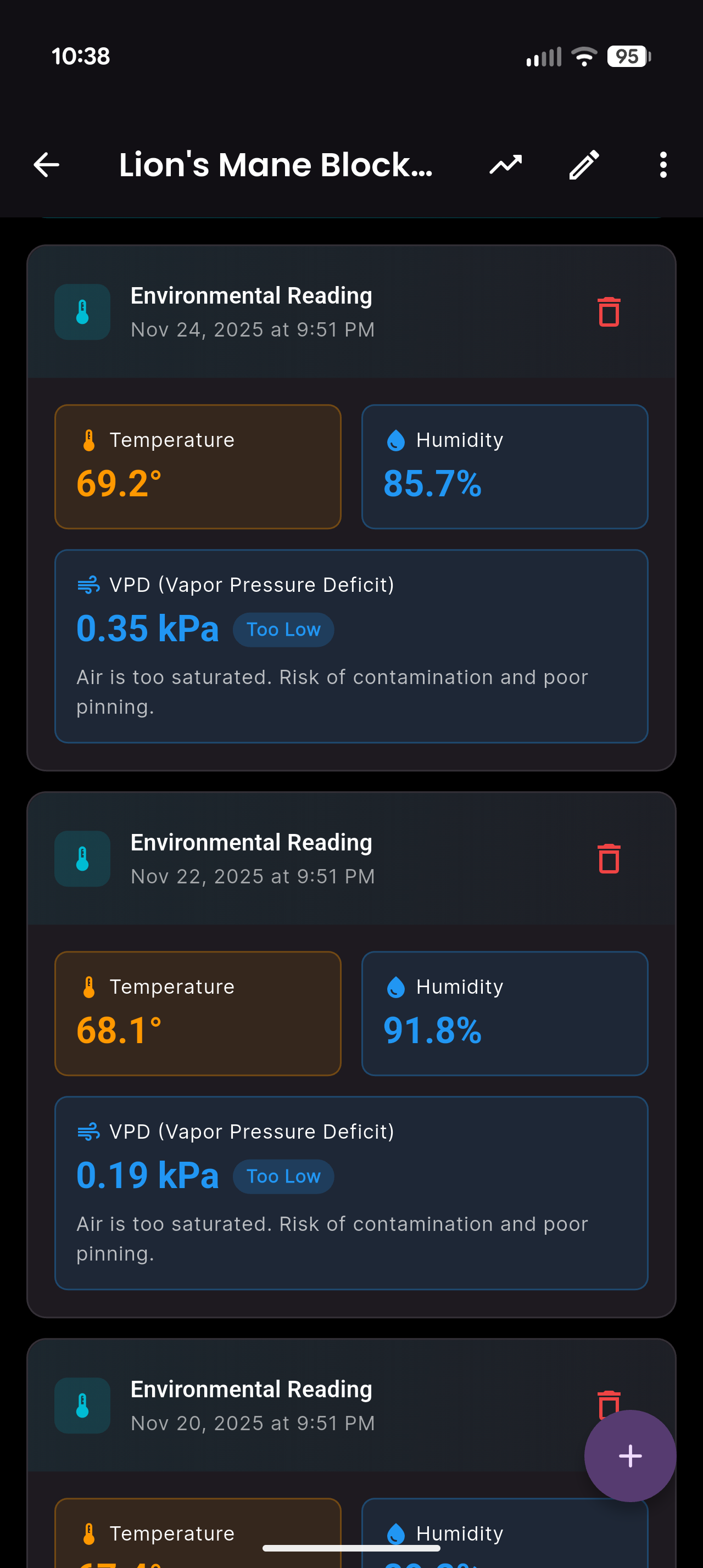
24/7 sensor data with historical charts and threshold alerts

Substrate Management

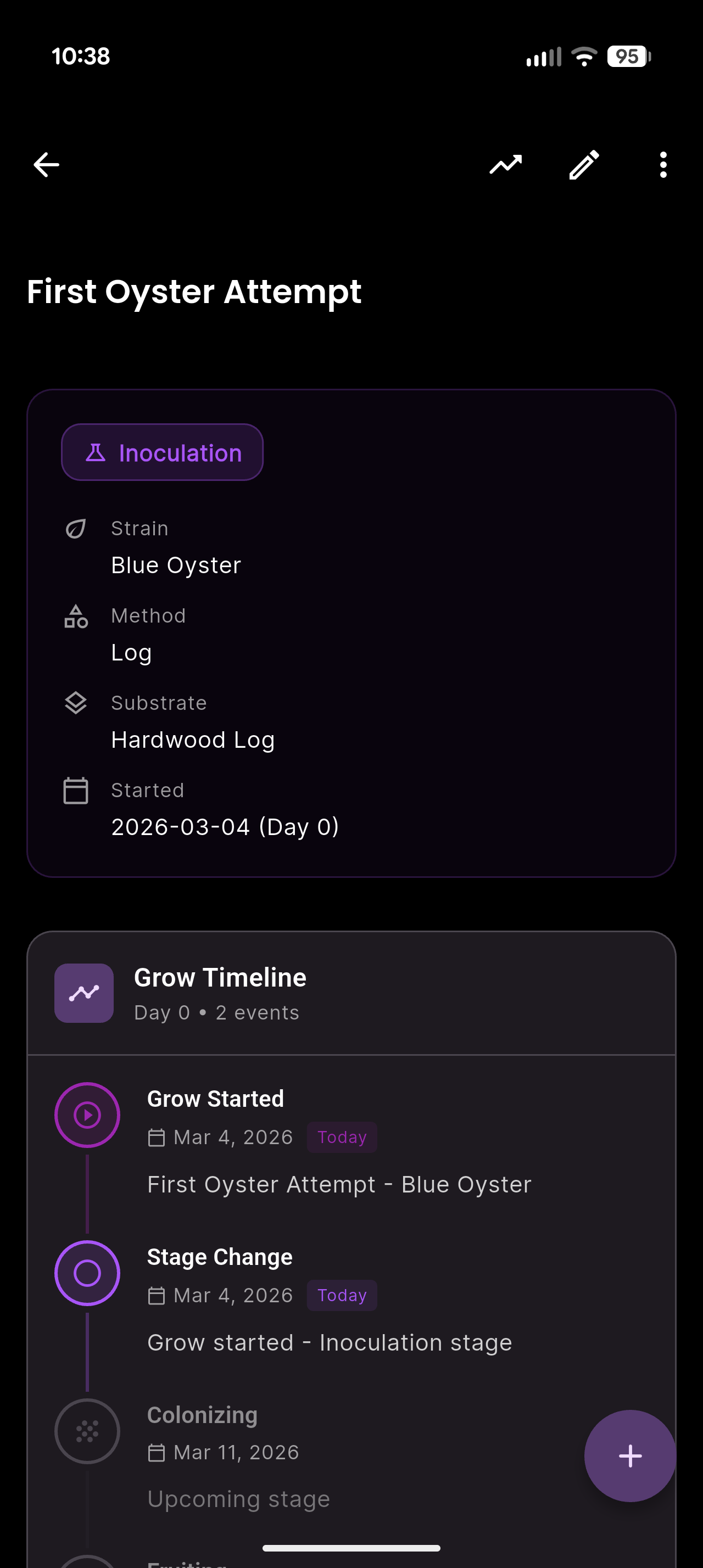
QR-based tracking from inoculation through harvest

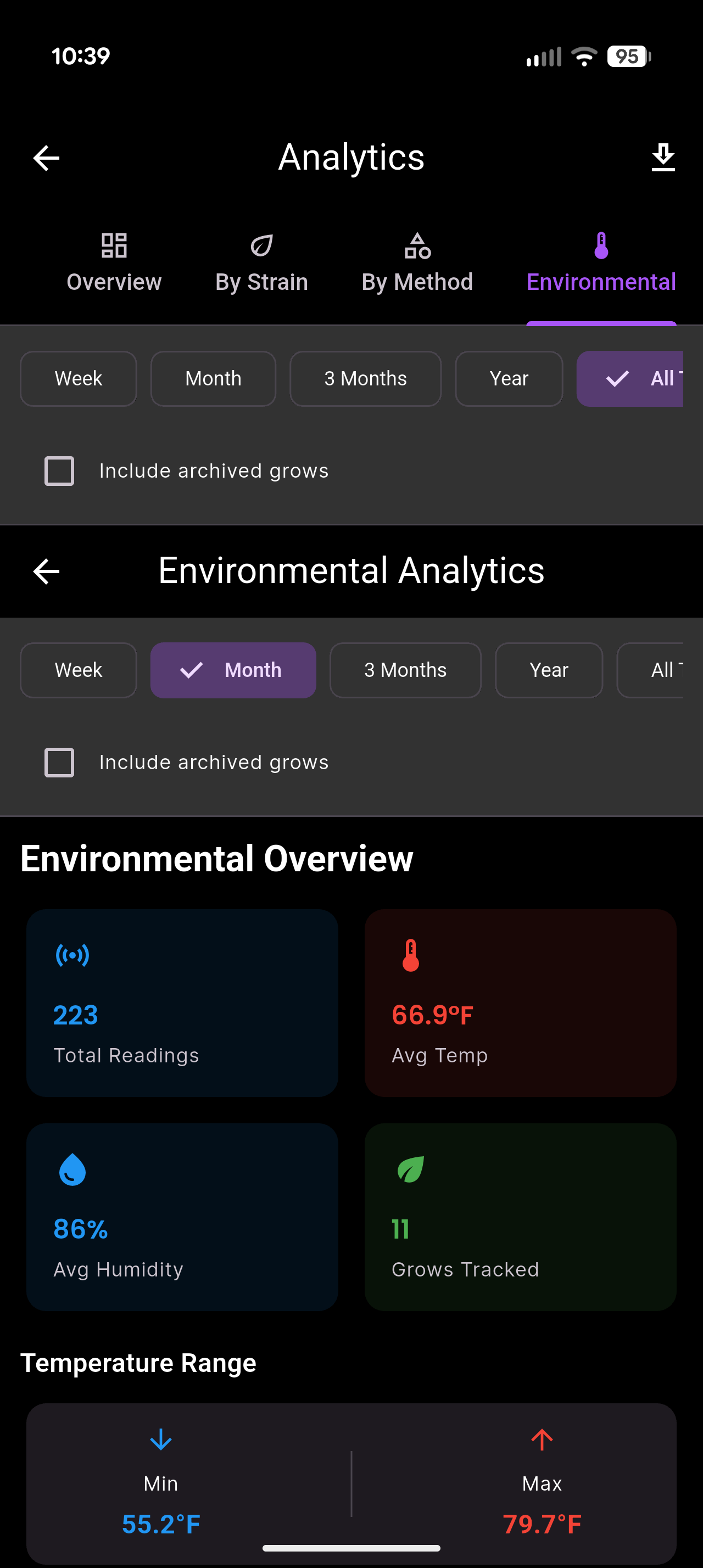
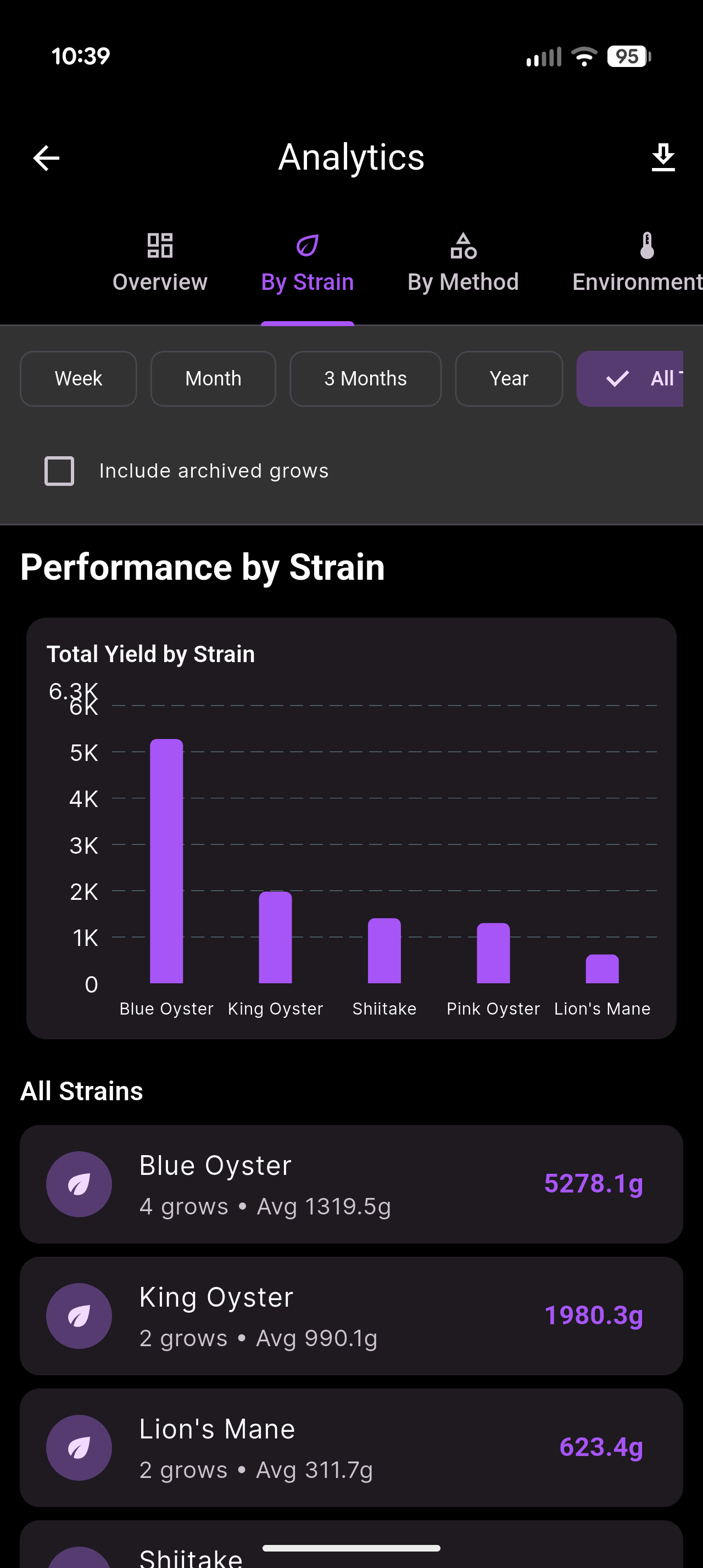
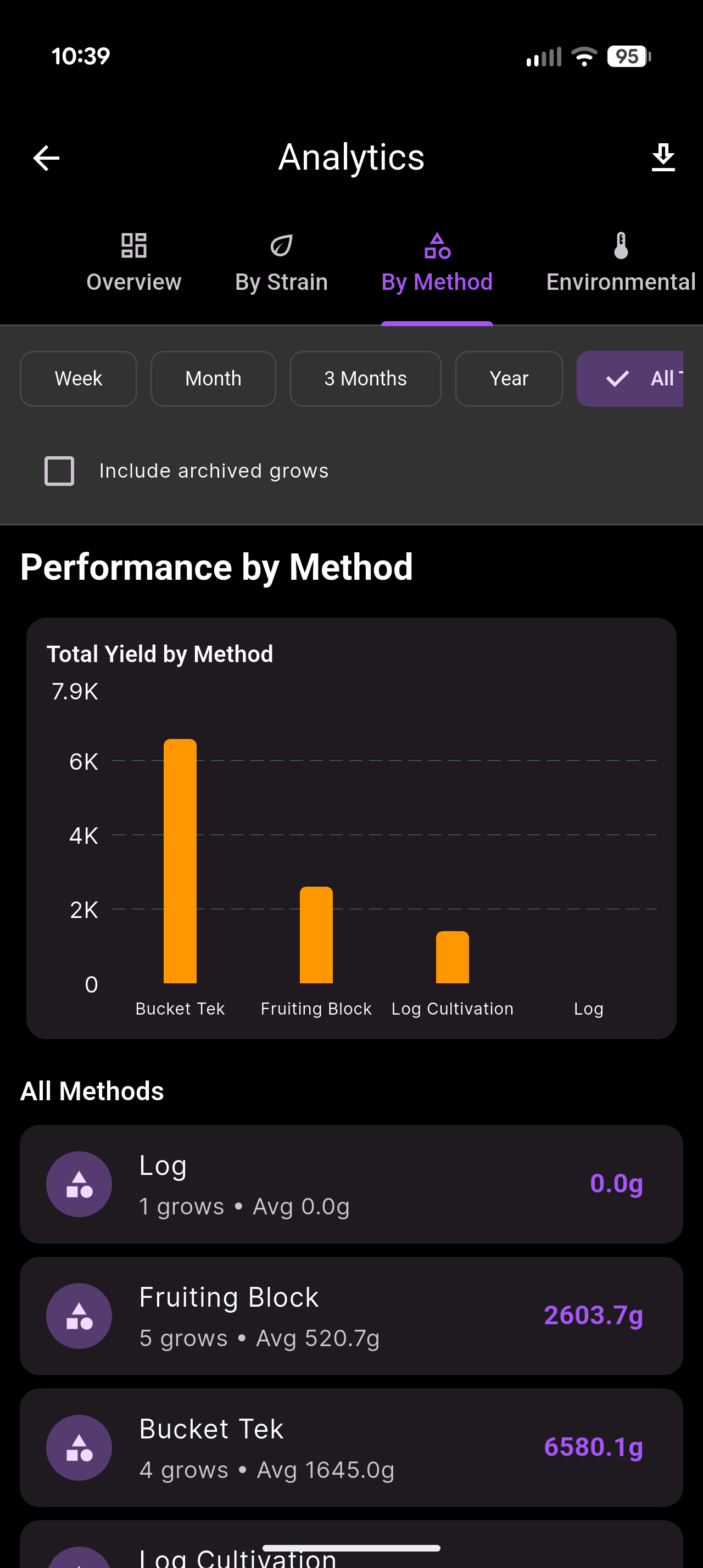
Harvest Analytics

Yield logging with species, flush number, and quality notes

Smart Alerts

Push notifications for out-of-range environmental conditions

Multi-Garden Management

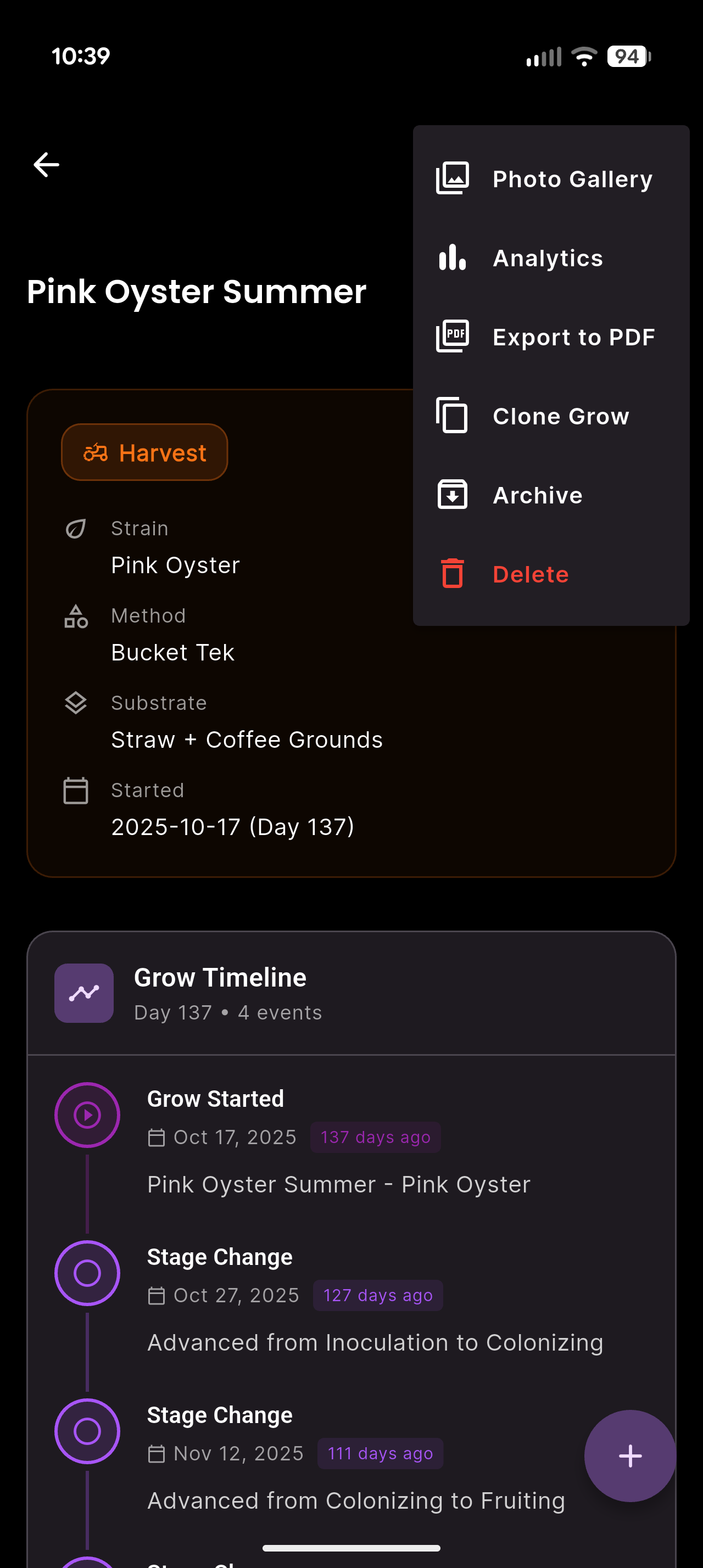
Track multiple cultivation projects simultaneously—from inoculation through harvest across different species and substrate types.

MycoLog gardens dashboard

Growth Stage Tracking

Visual status badges for each growth stage—Inoculation, Colonizing, Fruiting—with day counts since inoculation for progress tracking.

Species & Substrate

Track different mushroom species (King Oyster, Lion's Mane, Blue Oyster, Shiitake) and substrate types (fruiting blocks, bucket tek) across multiple simultaneous grows.

At-a-Glance Overview

Status summary showing 10 active gardens with counts per stage (1 inoculating, 2 colonizing, 1 fruiting)—quickly identify what needs attention.

Phase IV

Real-World Testing & Optimization

MycoLog is currently in closed testing with 2 users, with sensor integration under active development. The goal is to validate the core hypothesis: affordable IoT sensors combined with thoughtful mobile app design can deliver professional-grade monitoring at a fraction of commercial system costs.

The project is revealing important lessons about mobile hardware integration. Bluetooth compatibility requires extensive device testing—what works on one platform may behave differently on another. Battery optimization for continuous monitoring is critical; users need days of sensor runtime, not hours, for practical deployment in grow operations.

Most importantly, MycoLog demonstrates the potential of combining reusable component architecture (from Printory) with domain-specific customization and real-time hardware connectivity—pushing mobile apps into agriculture and industrial monitoring applications.

Critical Lesson

"IoT integration pushes mobile apps into new territory—bridging physical and digital worlds. The technical complexity is real, but the payoff is democratizing professional tools that were previously accessible only to well-funded operations. Affordable monitoring changes what's possible for hobbyists and small-scale producers."

2-Month Development Progress

An ongoing project pushing the boundaries of mobile IoT integration—from concept to closed testing with real sensor hardware.

1

Month 1: Core App & Domain Research

✓ Completed

✓ Architecture Adaptation

Reused Printory's component structure—QR scanning, data persistence, mobile-first UI patterns

✓ Domain Research

Studied cultivation parameters, growth stages, contamination risks, commercial monitoring gaps

✓ Core Features

Multi-garden tracking, substrate management, harvest logging, growth stage UI

2

Month 2: IoT Sensor Integration

⚙️ In Development

✓ Hardware Prototyping

Tested 3 sensor types (BLE, WiFi, Hybrid), evaluated cost/performance tradeoffs

⚙️ Bluetooth Web API

Building connection stability, data streaming, auto-reconnection logic—browser compatibility is complex

⚙️ Data Accuracy Testing

Validating against lab-grade instruments—targeting 99.2% accuracy for real cultivation use

Next Milestones

Complete sensor integration across all 3 device types
Implement push notification alert system
Expand closed testing to 5-10 active growers

From Concept to Hardware in 2 Months

Reusing Printory's architecture accelerated initial development—but IoT sensor integration is genuinely hard. Browser APIs, connection stability, battery optimization, and data accuracy require deep technical work. This is what makes functional prototypes exciting: pushing into unfamiliar territory where commercial tools are unaffordable or don't exist.

Project Impact Summary

2 Users

In Closed Testing

3 Sensors

IoT Device Types (In Development)

99.2%

Sensor Data Accuracy

Back to All Projects