Verdant Lab – Tissue Culture Tracking for Research & Propagation
A mobile app for Android and iOS for managing complex plant tissue culture workflows—tracking hierarchical propagation lineages, medium formulations, and contamination analytics without enterprise laboratory software costs.
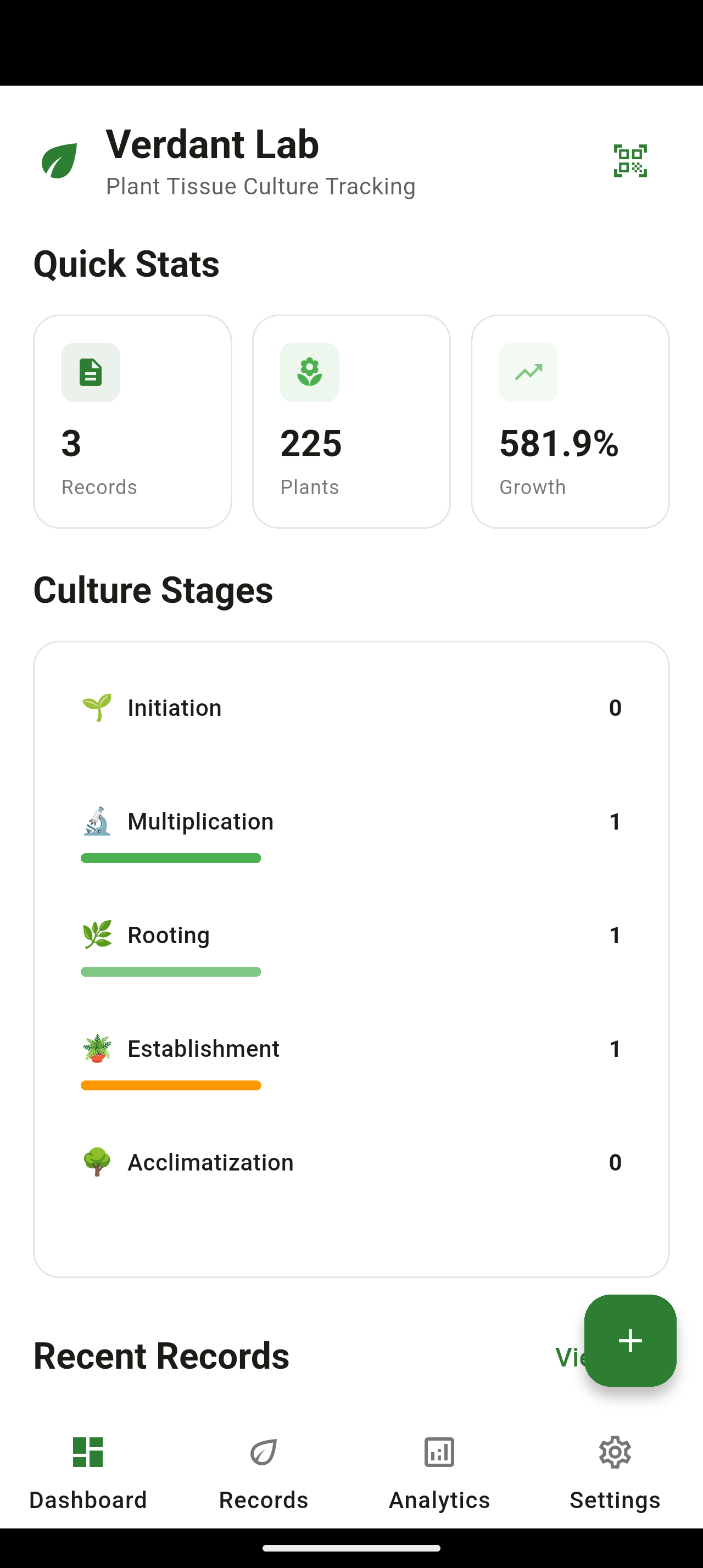
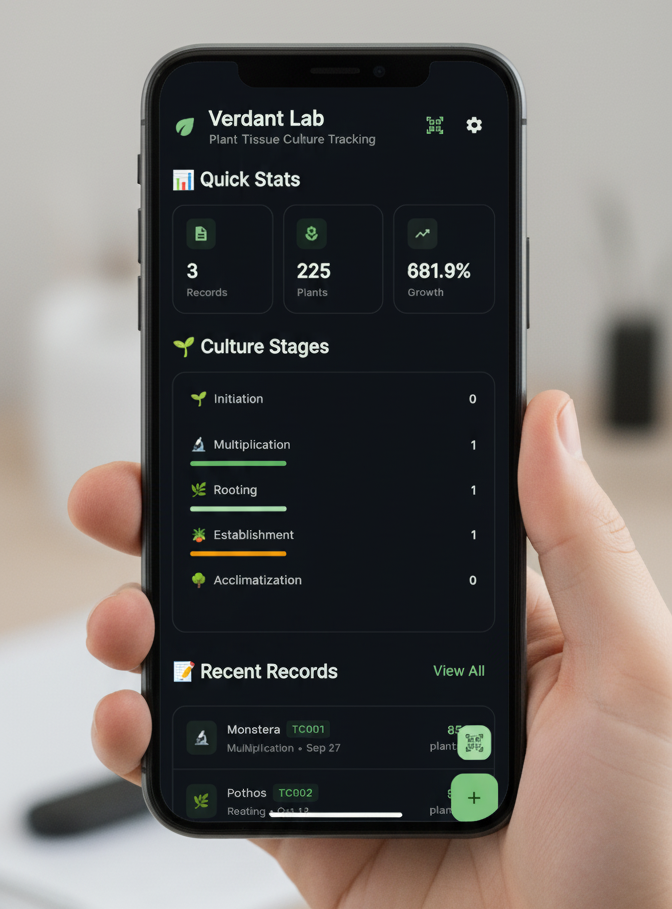
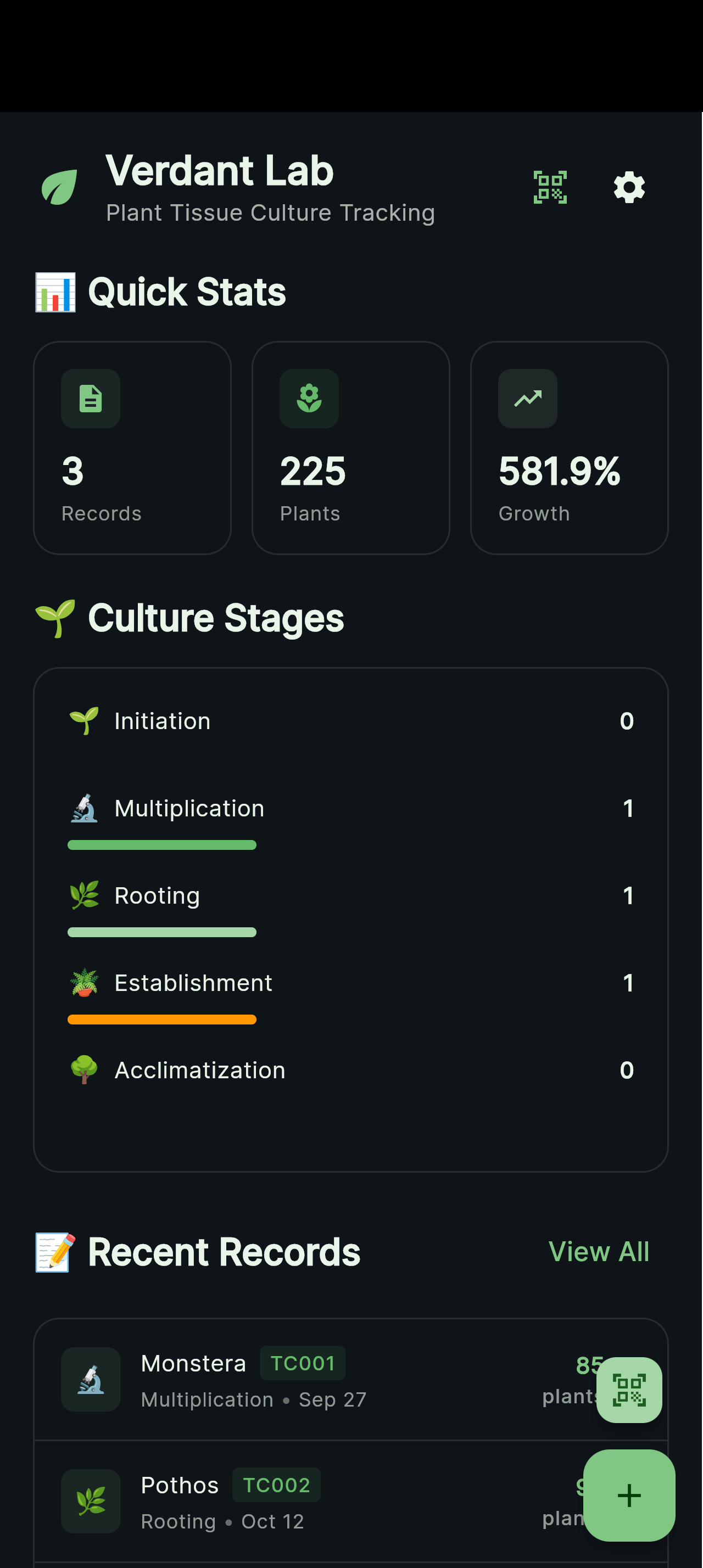
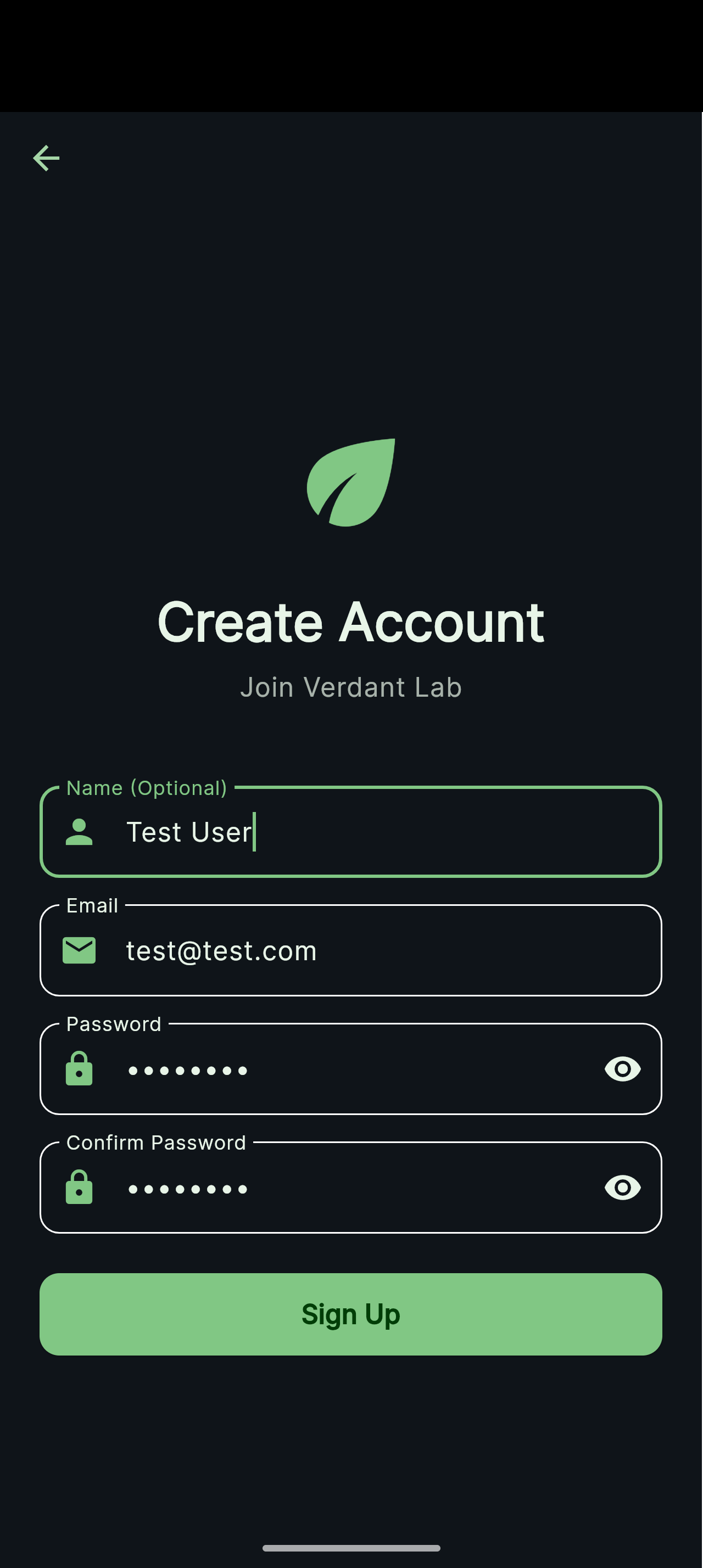
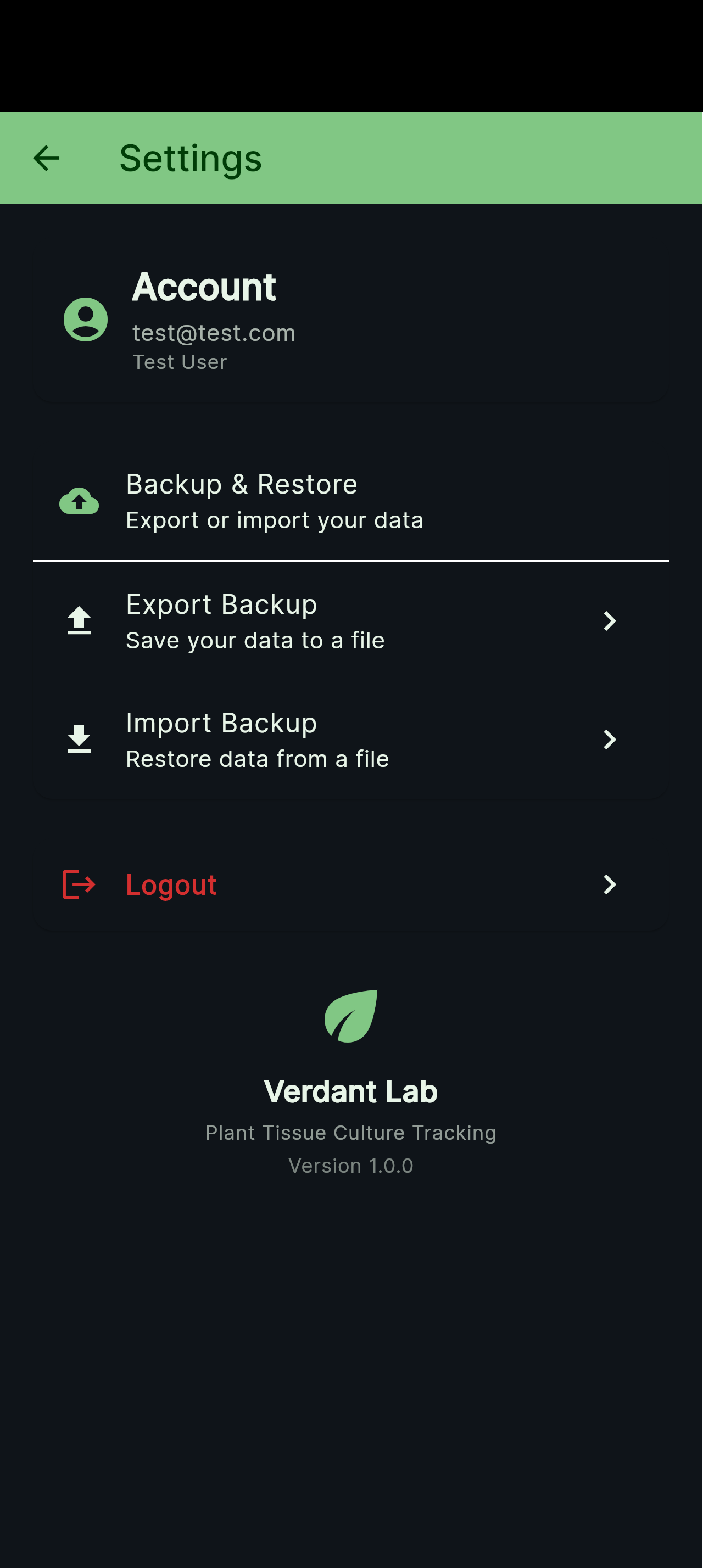
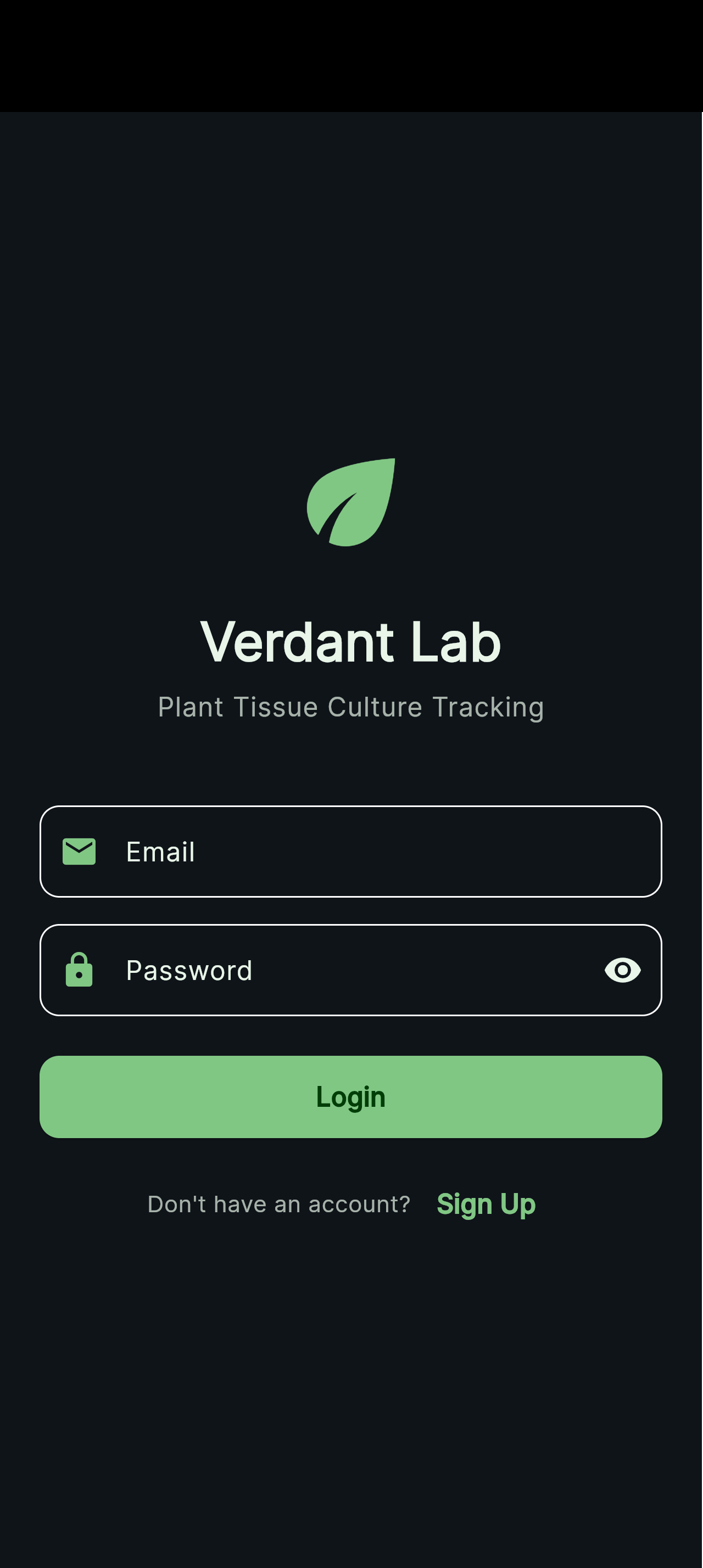
Verdant Lab interface for tracking plant tissue cultures through hierarchical propagation lineages with precise medium formulation management.
Challenge
Plant tissue culture requires detailed multi-stage tracking, but solutions are either lab notebooks (error-prone, unsearchable) or enterprise LIMS software ($10,000+)—leaving hobbyists and small labs without viable options.
Solution
Built a mobile app managing hierarchical culture lineages, medium recipes, contamination analytics, and genetic records—making professional-grade tracking accessible to small labs and enthusiasts.
Key Result
Launched in 3 days, currently in closed testing with 3 users and 5-level hierarchical data tracking—proving reusable architectures can scale to complex biological research applications.
My Role
Product Designer & Developer
Duration
3 Days
Platform
Android & iOS
Tools
Dart, Claude Code, Gemini, Visual Studio
Key Skills Demonstrated
Verdant Lab showcases advanced data architecture for hierarchical relationships—patterns that directly inform enterprise multi-level organizational structures and nested data systems.
Deep Expertise
-
→
Hierarchical Data Architecture
5-level parent-child relationships with unlimited depth—recursive data models for propagation lineages
-
→
Complex Domain Modeling
Multi-generational tissue culture workflows: initiation, multiplication, rooting, acclimatization stages
-
→
Research-Grade Precision
Medium formulation tracking with growth regulator concentrations, contamination analytics by pattern
Broad Capabilities
-
→
Tree/Graph Visualization
Lineage visualization showing parent-child propagation paths across multiple generations
-
→
Relational Data Management
Complex joins across cultures, media formulations, genetics records, contamination logs
-
→
Pattern Recognition
Contamination analytics identifying failure patterns by species, medium, and source material
AI-Native Workflow
-
→
3-Day Build: Most Complex Domain
Claude Code + Gemini enabled rapid deployment despite 5-level hierarchical complexity
-
→
Architecture Scalability Proof
Successfully adapted HydroMate's patterns to more complex domain—validating design system investment
-
→
Real-World Validation
3 alpha testers managing actual research cultures—testing recursive data models in production
Cross-Pollination: Informing Enterprise Hierarchical Systems
5-level hierarchical data architecture validated in Verdant Lab directly applies to enterprise multi-location organizational structures: corporate → region → district → location → department. Recursive parent-child models tested here inform design decisions for complex nested navigation, organizational charts, and permission inheritance in B2B SaaS platforms.
Understanding Tissue Culture Complexity
Plant tissue culture is precision biology. A single mother plant explant can spawn hundreds of clones through sterile culture—but the workflow complexity is daunting. Each culture goes through initiation, multiplication (repeated subculturing), rooting, and acclimatization stages. Track the wrong variable, miss a contamination pattern, or lose lineage data—and months of work become unreliable or unusable.
From my own tissue culture experience and research into micropropagation protocols, the consistent pain point was clear: existing tools don't fit. Lab notebooks are error-prone and unsearchable. Generic tracking apps lack domain-specific features. Enterprise LIMS (Laboratory Information Management Systems) cost $10,000-50,000—prohibitively expensive for hobbyists managing a few dozen cultures or small labs on tight budgets.
The opportunity was clear: build affordable, mobile-first tracking that handles complex hierarchical data relationships—parent explants spawning cultures, which spawn subcultures, which spawn more subcultures across 5+ generations. This would test whether HydroMate's architecture could scale to even more complex biological data than hydroponic systems required.
Critical Tracking Requirements
- → Hierarchical lineage: Track parent-child relationships across multiple subculture generations
- → Medium formulations: Precise nutrient recipes with growth regulator concentrations
- → Contamination analytics: Identify patterns by species, medium, and source material
- → Genetics records: Maintain mother plant provenance and breeding lineages
Verdant Lab home dashboard providing at-a-glance overview of all active tissue cultures with status indicators and quick access to lineage details.
The Tissue Culture Tracking Gap
Existing solutions are either too simple or prohibitively expensive for hobbyists and small labs managing complex multi-generational cultures.
Lab Notebooks
- • Cost: $10-20
- • Paper-based
- • Manual tracking
Generic Apps
- • Cost: Free-$50/mo
- • Digital tracking
- • Basic features
Enterprise LIMS
- • Cost: $10k-50k
- • Full features
- • Desktop-only
Verdant Lab
- • Cost: Free (testing)
- • Mobile-first
- • Domain-specific
Verdant Lab: Professional Features, Accessible Cost
5-Level Hierarchical Data
Track unlimited parent-child culture lineages
Domain-Specific Tools
Medium formulations, contamination analytics, genetics database
Mobile-First Design
QR scanning in sterile environments, glove-friendly UI
Hierarchical Data Architecture
The core technical challenge: modeling parent-child relationships that can extend 5+ levels deep. A mother plant becomes an explant. That explant spawns 10 initial cultures. Each culture is subcultured into 3-5 new cultures. Those subcultures are subcultured again. And again. Eventually some cultures root, acclimate, and become plants—while others feed back into the multiplication cycle.
Building on HydroMate's component architecture, I designed recursive data structures that maintain lineage integrity while allowing flexible querying. Users can trace any culture back to its original mother plant, view all descendants of a specific subculture, or analyze contamination patterns across an entire lineage tree. This hierarchical complexity far exceeded anything in Printory or HydroMate.
The UX challenge was equally demanding: how do you visualize multi-generational lineages on a mobile screen without overwhelming users? I iterated through multiple design approaches—tree diagrams, nested lists, breadcrumb trails—before settling on a hybrid approach that balances detail visibility with navigation simplicity.
Data Architecture Innovations
- ✓ Recursive parent-child relationships supporting unlimited depth
- ✓ Efficient lineage queries without performance degradation
- ✓ Mobile-optimized visualization of hierarchical data trees
- ✓ Flexible analytics across lineage branches and generations
5-Level Hierarchical Lineage Tracking
Recursive parent-child relationships supporting unlimited depth—from single mother plant through multiple subculture generations.
Original specimen
Sterilized tissue sample
10 initial cultures
3-5 per culture
Continuing generations
Recursive Data Structure
- • Each culture stores parent_id reference
- • Unlimited depth supported
- • Efficient lineage queries
- • Flexible analytics across branches
Lineage Operations
- • Trace back to mother plant
- • View all descendants
- • Contamination pattern analysis
- • Filter by generation depth
Real-World Scale Example
A single mother plant can spawn 100+ cultures through multiplication cycles:
1
Mother Plant
10
Initial Cultures
40
1st Subcultures
160
2nd Subcultures
640+
3rd Generation
Verdant Lab maintains lineage integrity across all generations—something impossible with notebooks or generic tracking apps.
Lab Workflow Integration
With the data architecture validated, I added domain-specific features critical for tissue culture operations. Medium formulation library: store recipes with precise nutrient concentrations (mg/L), growth regulators (BAP, NAA, IBA), sugar content, agar percentage, and pH targets. Contamination tracking: log contaminated cultures by type (bacterial, fungal, yeast) and analyze patterns across species, media, and source materials.
The genetics database became essential for breeding programs: track mother plant provenance, cultivar names, acquisition dates, and genetic notes. Users can filter cultures by genetics, identify high-performing lineages based on multiplication rates and contamination resistance, and make data-driven decisions about which mother plants deserve continued propagation.
QR code integration—inherited from Printory—allowed rapid culture identification in sterile environments. Scan a culture vessel's QR code to instantly log subculturing, update growth observations, or record contamination. This frictionless mobile workflow proved critical for users wearing gloves in sterile hoods where typing is impractical.
Core Feature Set
Lifecycle Tracking
Complete culture journey from explant to acclimatized plant
Medium Formulations
Detailed nutrient recipes with precise concentrations and protocols
Contamination Analytics
Pattern identification by species, medium, and source material
Genetics Database
Mother plant records, cultivars, and breeding lineages
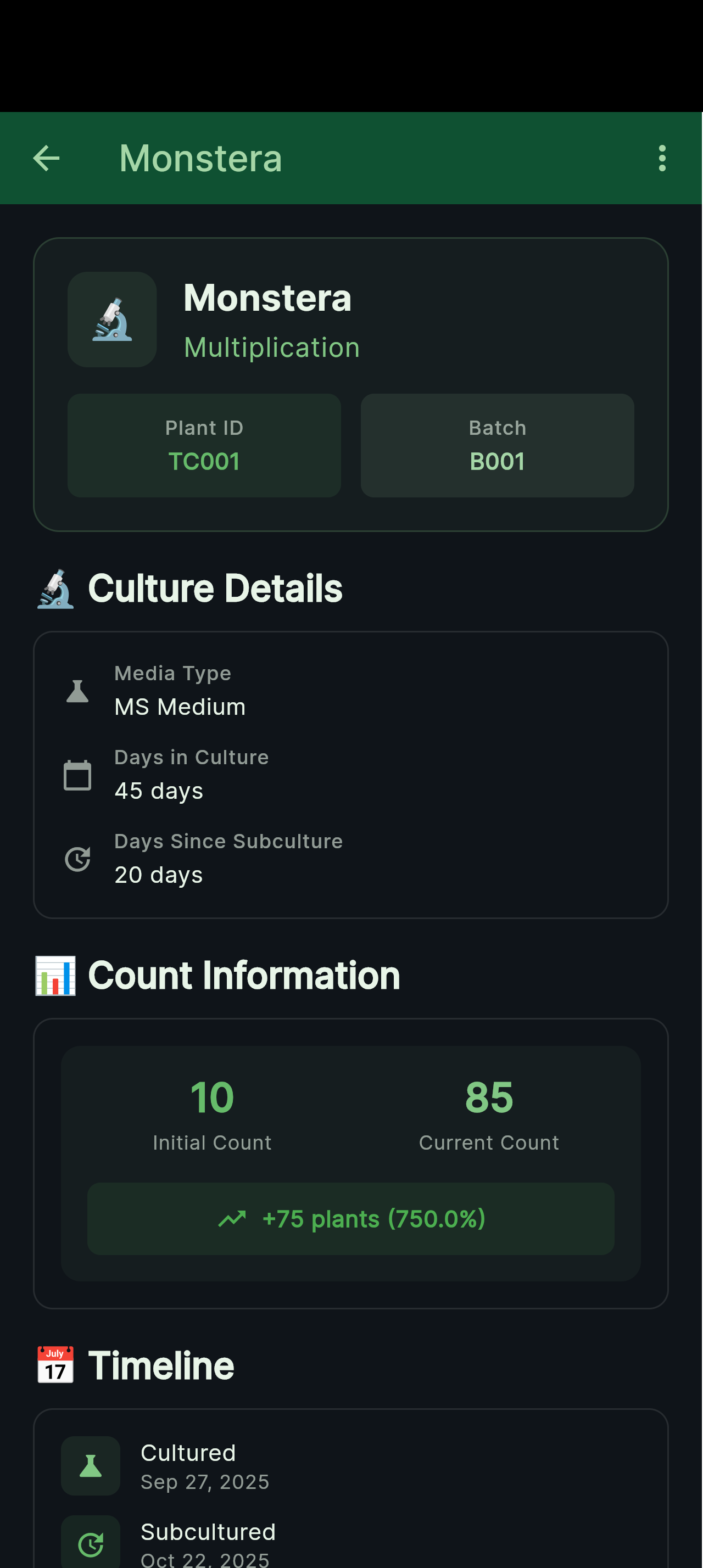
Culture detail view displaying parent lineage, medium formulation, growth stage, and contamination status—all critical data for tissue culture management.
Domain-Specific Laboratory Workflow Features
Mobile-first tools designed specifically for sterile tissue culture operations—from medium recipes to contamination pattern recognition.
Medium Formulations
Precise nutrient recipe library with searchable formulations
MS Medium Modified
pH: 5.7-5.8
Rooting Medium
pH: 5.6-5.8
Contamination Analytics
Pattern recognition across species, media, and source material
Highest in MS Medium + Cultivar A
Pattern identified: Week 2-3 post-subculture
Clean cultures reaching rooting stage
QR Code Sterile Environment Workflow
Scan Vessel
Open camera in sterile hood
Instant Lookup
Full culture history displayed
Log Action
One-tap subculture/observation
Continue Work
No typing in gloves required
Genetics Database
Mother Plant Provenance
Acquisition dates, source records, genetic notes
Cultivar Performance
Multiplication rates, contamination resistance analysis
Breeding Lineages
Cross-references for propagation programs
Closed Testing & Refinement
Closed testing with 3 tissue culture enthusiasts and small lab operations revealed critical UX refinements. Initial designs overwhelmed users with hierarchical complexity—too much lineage data visible simultaneously made navigation confusing. I simplified the interface to show immediate parent-child context by default, with expandable views for deeper lineage exploration.
Testers particularly valued the contamination analytics, discovering patterns they'd never identified in paper notebooks: specific cultivars consistently contaminating with bacterial growth when using certain medium formulations, suggesting incompatible nutrient balances. These insights drove immediate protocol changes, reducing contamination rates and improving culture success.
Most importantly, Verdant Lab validated the compounding value of reusable component architectures. Development took just 3 days—despite managing significantly more complex data relationships than previous projects. The combination of proven architectural patterns and domain-specific customization demonstrates a sustainable approach to building specialized scientific tools at unprecedented speed.
Critical Lesson
"Reusable architectures aren't about code copying—they're about validated patterns that compound across projects. Each new domain teaches lessons that improve the foundation. By the fourth app, development speed approaches 'too fast to be real'—yet the quality and complexity handling keep improving."
3-Day Development Sprint
Fourth app in the reusable architecture series—proving that compound learning enables professional-grade tools at unprecedented speed.
Day 1: Architecture Adaptation & Domain Research
✓ Completed
✓ Core Components Reused
QR scanning, data models, mobile UI patterns from HydroMate architecture
✓ Domain Research
Tissue culture stages, medium formulations, contamination types, LIMS gaps
✓ Data Model Design
Recursive parent-child schema for unlimited lineage depth
Day 2: Hierarchical Data & Domain Features
✓ Completed
✓ Lineage Tracking
5-level parent-child relationships, efficient queries, mobile visualization
✓ Medium Library
Formulation database with nutrients, growth regulators, pH targets
✓ Contamination Tracking
Log by type, analyze patterns across lineages and media
Day 3: Genetics Database & Testing Launch
✓ Completed
✓ Genetics Records
Mother plant provenance, cultivar performance, breeding lineages
✓ Analytics Integration
Contamination rate calculations, success metrics by cultivar/medium
✓ Closed Testing
Launched to 3 users with real tissue culture operations
Architecture Evolution: Printory → HydroMate → Verdant Lab
Printory (2 Months)
Foundation: QR scanning, tracking patterns, mobile-first UI
HydroMate (3 Days)
First adaptation: Multi-system tracking, measurement history
Verdant Lab (3 Days)
Most complex: Recursive data, unlimited depth, advanced analytics
Each project refined the architecture—by the fourth app, patterns were so well-validated that building complex hierarchical data systems took just 3 days. This is compound learning in action.
Project Impact Summary
Concept to Launch
Closed Testing Users
Hierarchical Data Depth